
On July 3, we got to sleep in until after 8am to partially recover from our late Parisian nights. At ten, we left for the airport to fly to our next destination: Munich.

Somehow, our Tour Manager, Peter, snagged a first class seat. From our peasant seats, the meals he and his fellow first classers were provided was tantalizingly close.

Maintaining our tour group’s air travel tradition, we took off late after sitting on the tarmac for forty minutes. But the flight was quick, and about an hour and a half later we were on the fancy double-decker bus we would ride in for the rest of the tour.


This bus was operated by Chris, who was great to us but not so much to other drivers who fail to abide by the rules of the road. At one point, a mail truck blocked our way, and I’m pretty sure he would have sideswiped that truck into the river if we weren’t on board. For us passengers, that meant that we didn’t just get to our destinations on time; we were early. Soon, Chris had us in the heart of Munich.

To get us going after the flight and to maximize what we could see in Munich, the first item on the agenda was a bike tour of the city. We chose our bikes at the rental place based both on seat height and handlebar flair.

In no time, we were off, bicycling in more or less straight lines.

The first stop was the Theatine Cathedral, right in the heart of Munich. The cathedral combines elements of baroque and rococo styles, two artistic movements intended to impress the viewers through ornamentation and “showiness.” We arrived just as the light was breaking through the windows by the dome, creating a cool effect at the rear of the cathedral.


It was a hot day in Munich at just over 80 degrees. To cool off, one of the travelers from one of the other schools with us found a handy water supply to splash on his forehead and neck.

Before there could be another misuse of church resources, we biked away at all the speed that 40 people of varying bicycling skill could manage.

By far the best part of the bike tour was the English Gardens of Munich, which are huge, even larger than New York’s Central Park. The great thing about touring Munich by bike is that we could cover miles over the mostly flat park. One of the most impressive features in the park is the Eisbach, a man-made stream that flows off the Isar River. It has a current where swimmers can just float along, kind of like a “lazy river,” only if the lazy river went 10 times faster and lacked any clear exit points.


Even in the shade of the park, it was a warm day. Some travelers came up with innovative ways of dealing with the heat.

The nice weather and access to water brought out the crowds to the English Gardens. This made bike riding a challenge since there was no clear indication as to whether bikers or pedestrians had the right of way or if there was a particular “lane” for bikers. That meant that we had to weave through pedestrians who evidenced a faith that our group would not run into them that was wholly unjustified.


Technically, it is against the rules to swim in the “river,” a rule we only discovered later. On this day, many people were swimming or floating on boogie boards or inflatables.

The most impressive part of the river is the surfing area, where the concrete bed of the river forms a curl, creating waves. Surfers would line up on either side and take turns surfing on the river wave.


While Munich authorities turn a blind eye to the verboten swimming in the river, they have allowed surfing, apparently caving to the reality that surfers are gonna surf. The surfing looks like fun, but the water under the wave is less than two feet deep. A sign in the area clearly conveyed the dangers to our group, even without the translation.

Near the surfer area, a couple of travelers tried out swimming in the river.

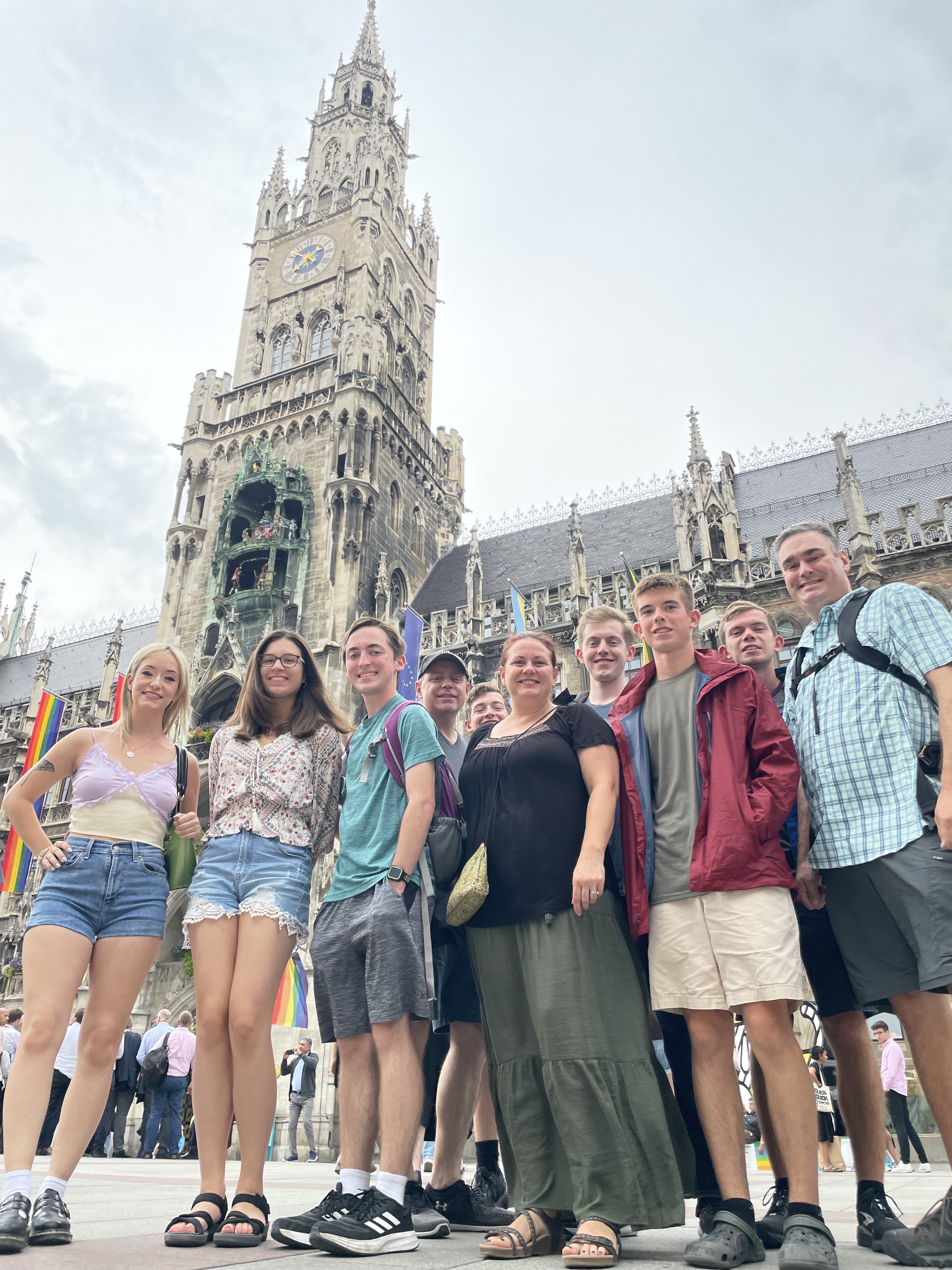
After the bike ride, we had dinner and then returned to the hotel. Not ready to call it a night and having enjoyed Paris so much at night, several travelers and I decided to return to the city center. There we got to see the famous Glockenspiel.

It turns out that late Sunday nights in Munich are pretty much the same as last Sunday nights in Richmond: there is not much going on. The many restaurants and beer halls were still active, but aside from drinking beer, there wasn’t much to do at that time. Against the odds, we did manage to find some entertainment, though, after Noah chose to tip the one street performer still awake at 10:30pm.
Finally extricating ourselves from crazy guitar guy, we returned to the hotel. The next day, we had breakfast at the buffet in the hotel, which was maybe the best we had seen on this tour. We experimented with different ways of consuming traditional German fare, like pretzels and pretzel rolls.

Munich’s location in southern Germany makes it ideal for day trips, and, on this day, the plan was to drive north from Munich to Nuremberg. Knowing that we would be gone all day, we smuggled out extra rolls and bread to eat as snacks later. Some mistakes were made in choosing which buffet items to steal.

Having illicitly provisioned ourselves, we were ready for a full day of travel and sightseeing. On this day, we would travel to the sites that illustrated how the Nazis controlled the people they ruled and that showed the methods used to bring Nazi leaders to justice. We stopped first at the first of the Nazi concentration camps, Dachau. While Dachau wasn’t intended by the Nazis to be a death camp in the way that Auschwitz was, the awful conditions and treatment of prisoners led to tens of thousands of deaths.


Unfortunately, a trade-off with the World War II tour is that while we would see many things, we would not have a lot of time to see most. We only had about an hour in Dachau, not even enough time to see the documentary shown in the museum, and then we left for Nuremburg. In Nuremburg, we first visited the Palace of Justice, where the war crimes trials for the Nazi atrocities, including the treatment of prisoners at camps like Dachau, were held.

The museum’s audio tour described how the court was developed, the commitment of the prosecutors to using existing international laws to try the Nazis, and the impacts of the outcomes of the trials up to today. We also had a chance to see the courtroom where the trials were held, which is still used for trials for major crimes, like murder, today.

Next, we took a short drive to the Documentation Center Nazi Party Rally Grounds, which is housed in the unfinished “Congress Hall,” designed by Nazi architect Albert Speer.

The museum inside explained not just how the Nazis used massive architecture and imagery as propaganda tools, but the legacy of Nazi use of these tools, showing examples of the influence on politics as well as on pop culture in films like Star Wars. After touring the museum, we entered the huge Congress Hall, a stadium that, if it had been finished, would have seated 400,000 people.

Next, we saw the Nazi Party Rally Grounds, which began as a zeppelin field before it was expanded by the Nazis. This is what the Rally Grounds would have looked like in the 1930’s:


Today, the Nazi imagery and much of the Nazi architecture has been stripped from the old Rally Grounds.

But the Rally Grounds exemplify the dilemma for Germans after World War II over what to do with Nazi architecture. Should it be torn down? Preserved as history? Converted to something new? In the case of the Rally Grounds, the Germans opted for a blend of the first and third options: having torn down the columns, the area is now used for public events. The day before we arrived in Nuremburg, the zeppelin field was used for a car race, and it is also used for concerts like the “Rock im Park” festival.

Even with the changes to the Rally Grounds, walking over them is a powerful and heavy experience. As we left Nuremburg and headed south, the experience became a little lighter. We began to pass the hops farms of Bavaria on the way to Munich, of the four ingredients allowed in beer under the Bavarian Purity Law, enacted in 1516.

In the early evening, we arrived back in Old Town Munich for dinner. For those travelers who had not joined us for the walk to see crazy guitar guy, this was their first view of the Glockenspiel. Under the clock, you can see the figures that, three times a day, put on a dance commemorating the marriage of one of the dukes of Bavaria and loyalty to the duke, but the last such “show” is at 5pm.

The restaurant where we ate had a retractable roof over the courtyard dining area, and on this evening, it was open to allow the cool air in. Forecasts had been predicting rain each day we were in Munich, and we had actually lucked out for most of the day. During dinner, that luck ended, as thunderstorms approached. The retractable roof was closed, but the rain was intense enough that waiters kept glancing up at the roof in a way that did not inspire confidence. Finally, the rain slacked off enough for us to ride to the hotel metro stop and walk to the hotel.

We needed to get out of the rain quickly with all of the breakfast buffet bread packets we were carrying around. We had a bad feeling about how that bread would react with water.

Next up: Salzburg!
One response to “Biking and Bussing in Munich and Nuremberg”
[…] night of July 4th, thunderstorms rolled through Munich, and the forecast for our trip to the Eagle’s Nest and Salzburg did not look good. When the […]