
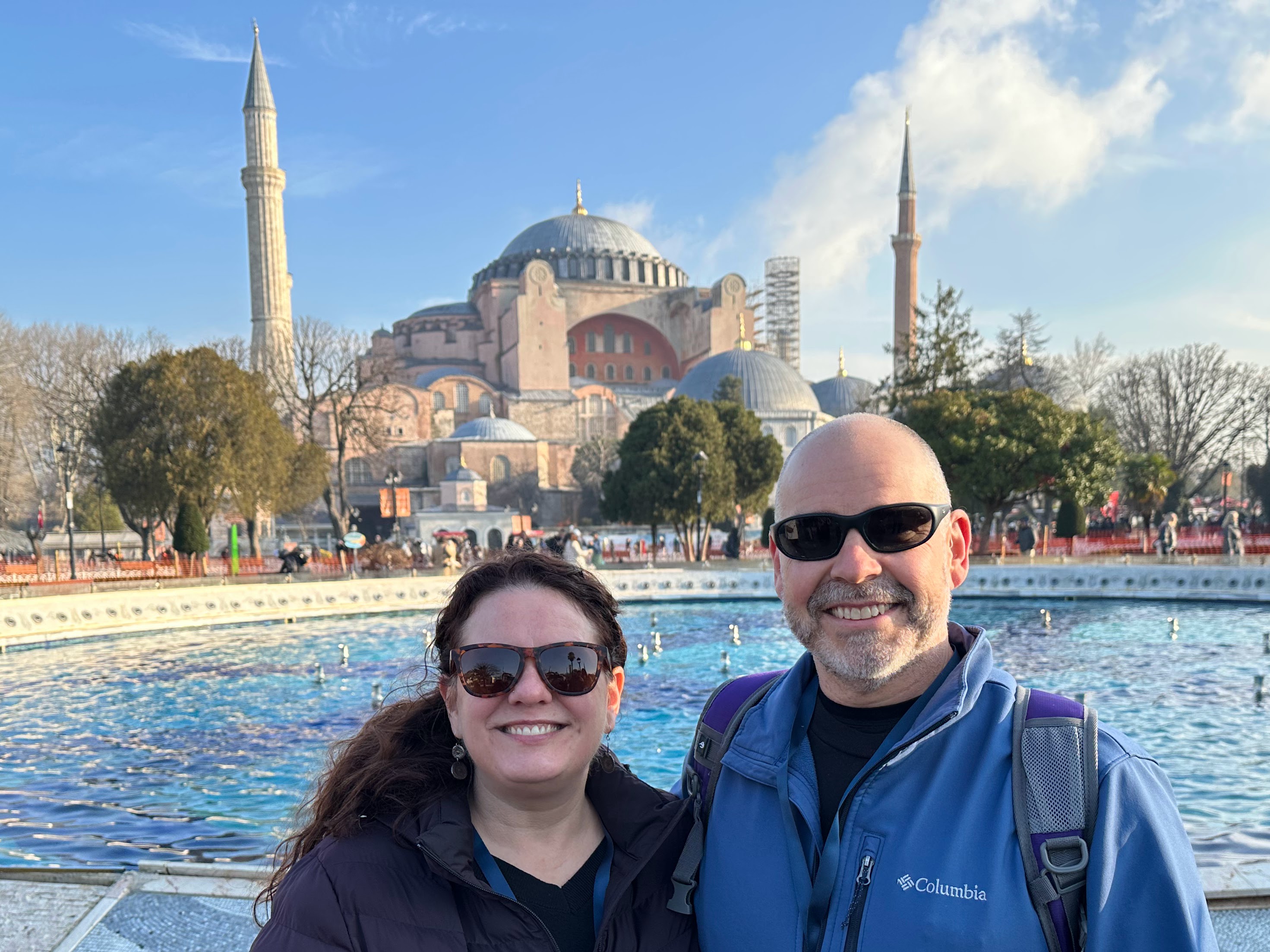
On January 15th, Laura and I left Virginia and headed to Istanbul. The city had been our list of places to visit for a long time, and some expiring “rewards” points from student trips we had led to Europe made it possible for us to see the city for the first time. After 20 hours or so of travel, from Richmond to Atlanta to Amsterdam to Istanbul, we finally approached the Istanbul airport around 4pm local time.

The airport in Istanbul is close to an hour from the city center, and the long cab ride introduced us to one of the few truly negative features of Istanbul: the ever present smell of nicotine. Smoking – and that’s old-school cigarette smoking, not vaping – was everywhere in Istanbul. On earlier trips to England, France and Germany we saw more people smoking than would generally be seen in the States, but Istanbul took smoking to another level, with smoking at cafes, in cabs, and at the bazaars. And keep in mind this is coming from someone who grew up in the 80’s with parents who smoked in the car, with the windows shut or barely cracked, while yelling at my brother Scott to stop making choking sounds because everyone knows that second-hand smoke can’t kill you. While our taxi driver mercifully abstained from smoking while we were in the car, the stale cigarette smell from nicotine that had apparently fused to the car seat fabric at a molecular level gave the taxi a nostalgic “family car on the way to the beach” odor. Somehow, we made it to the smoke-free Hotel Marmara Pera, gulped in the relatively smokeless air outside of the hotel, and observed smoky Istanbul from the safety of our 17th floor room.

For most of our student trips to Europe, we used the tour company ACIS, and our first ACIS “training” trip was exactly ten years before this one, to Barcelona. Both the Barcelona trip and this one overlapped with Laura’s birthday, and this Istanbul trip, which was part of an ACIS “global conference” of about 40 travelers, would be a big birthday for her: 50. We had already celebrated the occasion with bad plane sleep and some kind of breakfasty sandwich/roll fusion on the plane, but the celebration definitely improved when we hopped on a charter bus and headed to Taksim Square, a bit to the north of where we were staying, for our global conference reception.

The reception was at the top of the Hotel Marmara Taksim, giving us our second view of Istanbul at night. From the reception room we could see the “Old City” section of Istanbul, across the Golden Horn.

In 2023, Turkey, or Turkiye as the citizens of the country prefer it to be called, celebrated 100 years since the founding of the Republic after the dissolution of the Ottoman Empire that followed World War I. At Taksim Square, we saw banners with the face of the father of the country, Mustafa Kemal, that had been put up for the celebration, and, apparently like some of our Christmas decorations, destined to never be taken down. We also saw the first of many, many Turkish flags we would see. In most of the European countries I had visited, national flags were seen only at government buildings. In Turkiye, the national flag was as visible as it was back in the United States, with several enormous flags flying over downtown areas.


Istanbul had a long history, having been a Greek trading city, Byzantium, then a Roman capital, Constantinople, then the capital of the successor state to the Roman Empire in the east, the Byzantine Empire, and then a capital of the Ottoman Empire, a Turkish empire. The name was formally changed from Constantinople to Istanbul in 1930, leading Winston Churchill to complain in the most British way possible that “I do not consider that names that have been familiar for generations in England should be altered to study the whims of foreigners living in those parts. If we do not make a stand the B.B.C. will be pronouncing Paris Paree.” Name changes can be confusing for everyone, but especially for the elderly.
The long and winding history of Istanbul meant that there were all kinds of historic ruins, mosques, former cathedrals, and palaces to see in the Old City of Istanbul. Our tour therefore had a packed schedule, and early on our first full day, we crossed to Golden Horn to the Old City.


In addition to the many flags we saw in the city and the ridiculous number of feral cats that were everywhere, there were many, many fishermen.

Crossing to the Old City gave us our first up-close look at Istanbul’s most famous mosques, many built during the golden age of the Ottoman Empire. We would be visiting the three most iconic of the city’s mosques over the course of our tour.


We bypassed the mosques on this morning, though, saving them for later, because our first stop was for food, at the Deriliye Restaurant, which specialized in Ottoman palace cuisine.

This was one of the “cultural experiences” that was part of the tour. We would get a cooking lesson from the chef at the restaurant, and then we would make three of the starters served at the restaurant.

To make things more interesting, the tour group was broken into three teams that would complete to make the best version of each starter. We began by learning how to make a cherry leaf wrap, and then the contest was on.

We also made “sailor dough patties,” a kind of cheese pie, and a stuffed apple. Needless to say, our team won the contest. We are pretty much experts on how to make Turkish palace food now.

We “graduated” and then had a chance to eat professionally prepared versions of the foods we had made. I had heard from friends that Istanbul was an underrated food destination, and this was the first of several stops that confirmed that. I had come to the city not really a fan of baclava, but it turns out that baclava made from very fresh ingredients is awesome. And there were endless varieties of baclava that elevated this desert in my eyes, including intriguing chocolate variants. Turkish Delight, which in the US seems to mean a sort of fruit dessert that would only be eaten after the “good” desserts were gone, is also significantly better, especially the Turkish Delight “rolls.” It was all worth celebrating.

The next stop was the mosque of Suleiman, an Ottoman sultan so great he was known as “the Magnificent” by his European rivals. The Ottomans captured Constantinople in 1453, when Suleiman’s grandfather was sultan, and it was Suleiman who began the building program intended to make the city look once again like an imperial capital.

Istanbul is a hilly city, with the interior of the peninsula across the Golden Horn rising up above the straits. Situated on one of the hills, the grounds of the Suleymaniye Mosque also provide an amazing view of the city, both the European section across the bridge over the Golden Horn and of the Asian side across the Bosphorus.


We were visiting the mosque on a Friday, the Muslim day of prayer, and the prayers were going on when we arrived. While we were waiting to go in, we had a chance to see the mosque from the outside. The Suleymaniye Mosque was designed by the most famous architect of the Ottoman Empire, Mimar Sinan. When the Ottomans captured Constantinople from the Christian Byzantines, the most important structure, the Hagia Sophia, had taken Roman-style dome technology from before the fall of Rome and advanced it, building a round dome over a massive square structure. Mimar Sinan took inspiration from the Hagia Sophia, building a huge central dome, but then he innovated, surrounding that dome with a number of smaller domes.


The great mosques of the Old City are open to the public as long as prayers are not going on. To enter the mosque, visitors have to follow the Muslim customs of removing their shoes, and women have to cover their heads, a custom described in several parts of the Bible and still practiced by some women in the other monotheistic religions that claim Abraham as a founder, Christianity and Judaism. We adjusted our outfits accordingly and then entered the mosque.

The interior of the mosque is massive, with the central dome almost 175 feet off the ground.

In Islam, the rule against idol worship found in the Ten Commandments has generally been much more strictly interpreted than it is in Christianity. Rather than the depictions of holy people that you might find in a Catholic or Orthodox Christian cathedral, the art in the mosque features geometric representations of the infinite nature of God or floral designs.


From the calm, sedate atmosphere of the mosque we went to somewhere that was not at all sedate: the Spice Bazaar. And we were visiting on a Friday afternoon when the crowds and energy would be amped up even more. Istanbul’s population is huge, around 17 million people, which is about the same as the Greater Los Angeles area. Add to that the tourists from all over the world and you get an exceptionally busy bazaar.

In the crowded Bazaar, we found that most of the shoppers did not share our American conceptions about personal space or walking-lane etiquette. In America, a person walking toward you and then making no effort to avoid bumping shoulders would probably be seen as instigating a fight, but in Istanbul, bumping or even shoulder-checking another pedestrian was no big deal. The vendors were only slightly less aggressive than the shoppers, energetically appealing to pedestrians to come into one of the many stores selling spices, desserts, or Turkish lamps. While we were there, Laura was on the lookout for souvenirs for people back home, and we decided to leave the Spice Bazaar to see if the crowds and prices were better in the outdoor shopping area that radiates in every direction from the Spice Bazaar.

On this Friday night, there were few open spaces with all of the shoppers on the bazaar roads, but, to make things crazier, randomly people would come DRIVING THROUGH ON SCOOTERS, indignantly honking to get people out of the way while ignoring the law of physics that clearly states that two objects cannot occupy the same space at the same time. After about five minutes of this insanity, we returned to the relative peace and quiet of the indoor area of the bazaar. There, while wondering aloud where we could find some coffee, an enterprising salesperson alerted us to the fact that there was a lot of tea to be purchased in the Spice Bazaar.

This vendor gave us tea samples, and the tea was actually really good, prompting Laura to try to solve the souvenir issue by buying enough to give away as gifts. However, when we agreed to the purchase, we overlooked the fact that we only had about 10 minutes to work out a deal with a merchant who seemed to think that we were extravagantly wealthy Americans. Complicating matters further, we were making the purchase in Turkish Lira, which involved a monetary conversion that added way too much math for the late afternoon, and we were buying goods which would be measured in something called “kilograms.” All of this transformed the experience into the most painful math word problem I have ever attempted. So if anyone is in our neck of the woods and happens to want some Turkish tea, I have good news for you.

We returned to the hotel to offload several kilos of tea, and then we headed to the upscale Osman Bey neighborhood for dinner. The atmosphere in the neighborhood was significantly calmer than at the Spice Bazaar, and the neighborhood had decorated for New Years using Christmas lights and trees, apparently because it is bad form in a Muslim country to say that you are decorating for a Christian holiday. Maybe someone should tell them about Christmas in Japan.

Two things were once again made clear to us about Istanbul at the restaurant: people in Istanbul love meat and they love to smoke, sometimes at the same time, and even signs like this in the restaurant we visited were not enough of a deterrent:


Fortunately, the cigarette odor was overwhelmed by the good smells of vast quantities of meats cooking. The variety of kebab meat served at this restaurant was intimidating, as it kept coming in wave after wave. We had been warned by one of our guides that eating at this restaurant was a “marathon, not a sprint,” but that still didn’t prepare us for the apparently endless portions of ground lamb, steak, chicken breast, shaved beef and more.

The next day, we had two A-List attractions on the agenda: the Hagia (pronounced eye-uh) Sophia and the Blue Mosque. Of the two, the Hagia Sophia was much older, built by the Byzantine Emperor Justinian in 537. When the Ottomans took Constantinople in 1453, it was converted to a mosque and the minarets were added. We got to see it on an almost perfect January day.


In addition to the central mosque complex within the Hagia Sophia, there are remnants of Byzantine mosaics along the outer walls from when the structure served as a cathedral. This was the part of the structure we would be touring, so we circumvented the main mosque area and accessed the Hagia Sophia through the Hallway That Time Forgot.

As we emerged from the tunnels, the sunlight hitting the dome and windows of the Hagia Sophia was spectacular. The windows around the base of the dome are similar to those of St. Peter’s Basilica in Rome, although the dome of the Hagia Sophia is even higher, at 180 feet tall. Combined with the length of the structure, almost a football field long, this created a cavernous space inside.


When the Hagia Sophia was first converted to a mosque, the Ottomans plastered over the Christian mosaics, as these depictions of religious figures alongside emperors and empresses had been intended to reinforce the religious authority of those Byzantine rulers. Fortunately, when the plaster was later removed, many of the mosaics survived.


There was one bit of controversy when we encountered the mosaic below, showing Jesus making a gesture with three fingers to represent the Trinity and two fingers together to represent the dual nature of Jesus. Many Orthodox Christians hold their hands this way to make the sign of the cross.

The mosaic led Laura to ask some Orthodox members of our tour group if they signed the cross with three fingers, and, if so, how that worked specifically. Consequently, while staring intently at Jesus, Laura and these other travelers kept making the sign of the cross repeatedly. This alarmed the Turkish guard standing under the mosaic, who seemed to think that Laura was desecrating the holy mosque with her Christian idolatry. Fortunately, Laura was able to convey her ignorance of Christian theology in a way that transcended the language barrier, calming the guard down. A lesson was learned on this day. In the Hagia Sophia, signing the cross while looking at Jesus is sacrilegious, numerous feral cats making the mosque their home is not sacrilegious.


We left the Hagia Sophia and its many cats behind, and our next destination was the Blue Mosque, situated nearby. Because we are old, we knew we would never be able to make it all the way through the second mosque without going to the bathroom, and we stopped at a restroom before continuing.

It was actually my fault that I ended up in the pit toilet stall, because Istanbul’s touristy areas also had sit-down toilets, with special symbols on the door to indicate what kind of toilet was in the stall. But having found myself in this stall, I was impressed, to be honest, at just how remarkably clean the area around the pit toilet was. I have been in some public restrooms in the US with sit down toilets where there is so much fecal matter sprayed in so many different directions that I would need a police ballistics report to establish the position of the shooter. So kudos to the pit toilet users of Turkey and their exemplary aim. And to be clear to those of you frightened by the prospect of traveling to Istanbul and ending up in a stall with a pit toilet, most of the toilets that we encountered in Turkey were pretty amazing.

The built-in bidets that were prevalent in Istanbul removed the confusion some of our student travelers experienced when first seeing a stand-alone bidet. On one trip, at a hotel in Italy, some students called us to their room, alarmed at the malfunctioning “sink,” which turned out to be the bidet. In their defense, when they turned on this particular bidet, it shot a high-powered stream of water past the toilet, through the bathroom door, and almost to the hotel room door, a solid 12 feet away, in a jet of water so powerful the user would surely be purged of all impurities consumed in the past decade. At any rate, having broadened our cultural horizons by exploring the many restroom tools available in Istanbul, we were off to the Blue Mosque.

This mosque was built later than the Suleymaniye Mosque that we had toured earlier, with construction starting soon after 1600, at a point in Ottoman history when sultans would have been trying to prove that they were as great as the sultans who originally established the empire. The Blue Mosque was influenced by the earlier mosques but intended to be even greater, with the sultan who ordered its construction, Sultan Ahmet I, clearly trying to upstage the Hagia Sophia.

Like the Suleymaniye Mosque, the interior of the Blue Mosque has many, many intricate mosaics in geometric designs, with over 20,000 tiles total. The blueish tile used to decorate the mid-level of the mosque gives the Blue Mosque its name.

The architect of the Blue Mosque was a student of Mimar Sinan, and there are definite similarities between the Suleymaniye Mosque and this one. A difference is that the main dome of this mosque is surrounded by four “semi-domes,” giving the mosque more of a mountainous or cascading feel than experienced at the Hagia Sophia or Suleymaniye Mosque.


To support the dome and half domes, the mosque has four massive columns forming a square in the interior. The Redwood-sized columns are wide enough that entire tour groups could gather at the base.

Outside in the courtyard, we saw another of the mosque’s distinctive features – the six minarets. At the time the mosque was built, only the Great Mosque of Mecca, the holiest in Islam, had six minarets, which made the six towers of the Blue Mosque controversial. The legend goes that Sultan Ahmet asked for gold minarets, “altın minareler,” but the Chief Architect misheard this as “altı minare,” or six minarets. Oops. Sultan Ahmad totally did not mean to one-up the Great Mosque.

Next up: Istanbul’s Cats, Turkish Carpets, and Towers
One response to “Monumental Mosques and Busy Bazaars in Istanbul”
[…] our Blue Mosque visit during our Istanbul Tour in January, Laura and I were off to our next destination, a “cultural experience” at the Istanbul […]