
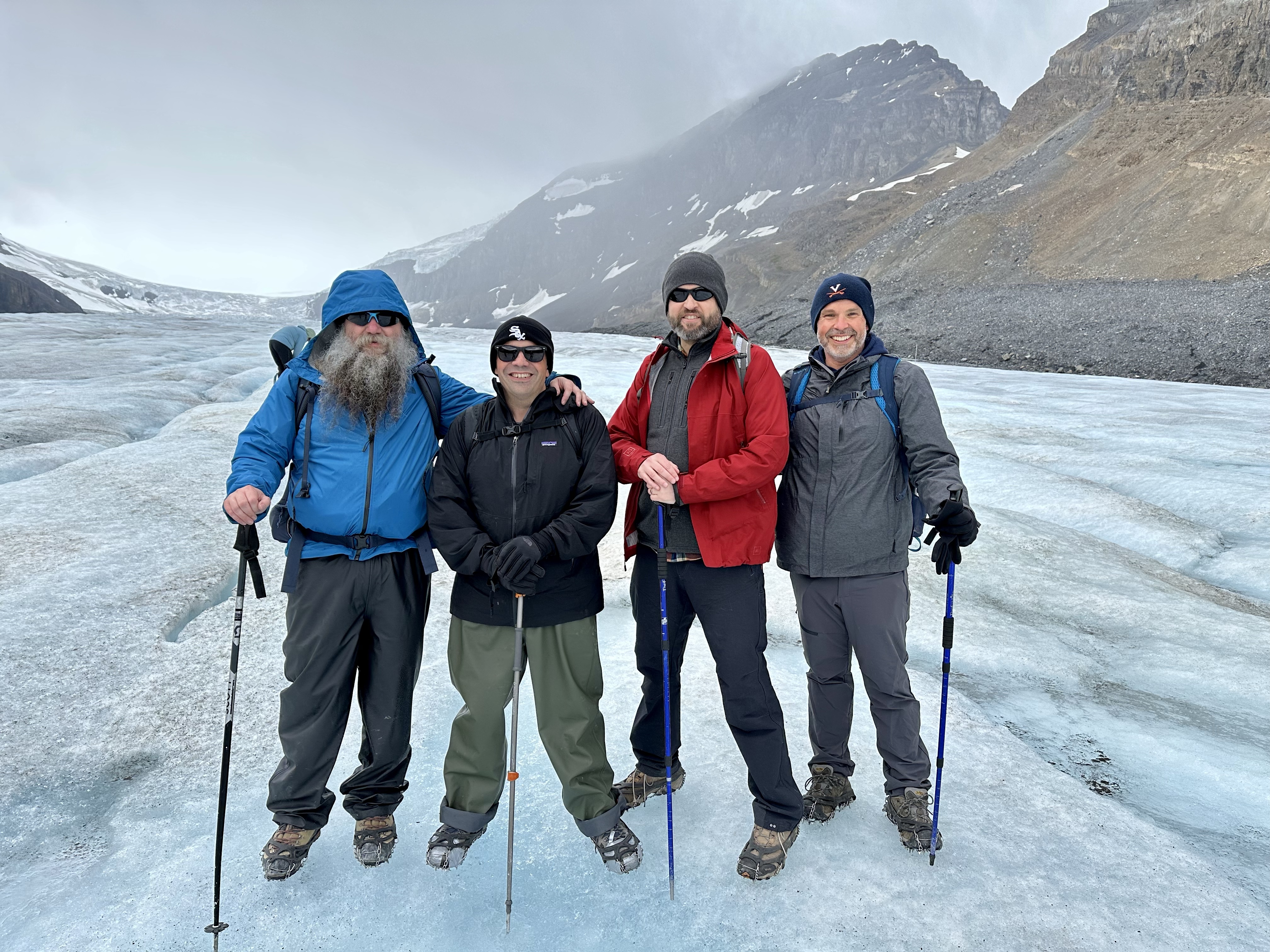
On July 17th, Jason, Jerry, Jim and I packed up and headed north from our place in Canmore, leaving Banff to go to Jasper National Park on Canada’s scenic Icefields Parkway. We were going on a four hour tour of the Athabasca Glacier, part of the Columbia Icefields, at 10:30am. That meant getting getting an early start for the two hour and 15 minute drive north.

The views from the road were absolutely amazing, and, at this point, it looked like we were in for perfect weather for the glacier walk. Because we are all old and prone to waking up at unnatural hours anyway, we had actually left Canmore even earlier than we had to, giving us time to make approximately 30 stops at scenic viewpoints along the parkway.


By the time we reached the region around the Athabasca Glacier, clouds were starting to roll in. The views of various glaciers that are part of the Columbia icefields were spectacular no matter the weather, but the damp chill in the area made me feel better about having brought a shirt AND a long sleeve shirt AND a hoody AND a rain jacket.

We arrived at the Glacier View Lodge, put on our extra layers of clothing, and then checked in with our tour company, Rockaboo. They informed us that rain was almost certain during the tour and that there was also the possibility of thunderstorms. The Rockaboo guides were well-prepared for a wet walk, and they supplied rain pants for everyone who lacked waterproof pants and encouraged anyone wearing running shoes to trade those out for the boots they provided. They also furnished crampons, ice spikes, to fit over our shoes and boots. Once all the people signed up for the tour had arrived, they gave us their safety spiel. All of the tour participants had completed an online liability waiver for the company already, but the company had us complete a second waiver, this time expressly exempting the company if something went wrong due to their negligence, AND they had everyone verbally confirm that they had read and understood the liability form. Completing two written and one verbal liability waiver was not exactly confidence-inspiring since we about to go walk on a sheet of ice pocked with deep watery pits. But it was too late to back out now, because who knew if we would ever be back, right? Maybe this was a once-in-a-lifetime trip. See how that line of reasoning restored your confidence? Having taken complete responsibility for a walk onto a landform I had no experience with in a country whose liability laws were completely unknown to us, it was time to set out for this potentially once-in-a-lifetime experience.

The walk from the drop-off point to the glacier was almost exactly one mile, and we passed many signs that the glacier was continuing to shrink. Since 1890, the glacier has receded almost a mile, and it is currently shrinking at over 16 feet a year. By the time we reached the stream pictured below, we had already passed a marker indicating the extent of the glacier in 1948, just 75 years ago.

The walk over the glacier-deposited rocks was challenging enough that we started to warm up, and I started to wonder if I hadn’t been overzealous with all of my clothing layers. Once we reached the edge of the glacier, though, a cool breeze blew off the ice, and the layers were increasingly worthwhile. Before we ventured onto the ice, it was time to put on our crampons.

If you have never used glacier spikes, they are incredible, giving us such secure footing on the ice that I was thinking that this was something I could use in everyday life. I mean, who couldn’t use surer footing when grocery shopping or mowing the lawn.

Walking on the glacier was an incredible experience. I was already much less regretful of the two liability forms I had signed exempting the tour company of any responsibility for my well-being.


The more we walked up the glacier, the grayer the clouds. We had been hoping that the storms would skirt us to the south, but that didn’t look likely at this point.

Then the skies opened up, and a driving rain started, blowing from the direction we were walking. It started pouring, and even our “water resistant” gloves and clothing were quickly soaked through. Then we heard a crack of thunder, and Jerry and Jim both spotted lightning. When one of our guides was asked what we would do if the lightning started approaching, the response was “run,” which was probably an example of understated Canadian humor. Probably. However, in the moment, the response was almost as confidence-inspiring as completing a second liability waiver. Fortunately for us, the thunderstorm moved on quickly. Unfortunately, a sleet storm moved in to take its place.
Just when it seemed like we were in for a long and miserable weather experience, the rain and sleet stopped. With the wind no longer driving ice into our faces, we could look around and appreciate the glacier. It was like being on another planet.


It was amazing being able to navigate that landscape, and equally amazing how sure-footed the glacier spikes made this group. I could even jump between ridges and stuff.


The part of the glacier we were walking on was probably several hundred feet thick. Our guides did a great job of showing us different features of the glacier, like the hidden streams under the ice and waterfalls.

When Jason wondered out loud if falling into this ice crevice would be the worst way to die, one of our guides provided a compelling counter-argument detailing how death by avalanche would be worse. Whichever way I died, the tour company would be entirely blameless.


After several hours on the glacier, we reached the edge of the ice, took off the crampons, and returned to our shuttle. A sign along the way back offered a depressing look at how rapidly the glacier was dying. When I was 9 years old, the glacier reached this point, a couple of football fields away from where the glacier reached in 2023.

One error we had made on our way to the glacier was driving by the only gas station between Lake Louise and the town of Jasper on the Icefields Parkway. Our rental car’s fuel estimate had led us to believe that we had plenty of gas to reach Jasper, but soon after we passed the station, the fuel estimate began to drop alarmingly, even over level road. By the time we reached the glacier, the gas level was at a point where we would probably reach the station in Jasper, but we would definitely be able to reach the station we passed if we backtracked, which is what we chose to do. It was here that we encountered an obstacle even worse that glacier thunderstorms or navigating boulders deposited by glaciers: the dreaded one-lane alternating construction stop light. Somehow, we had forgotten the construction on a bridge on the way, and someone had set up the construction light controlling the flow across the one lane bridge to cause maximum evil by giving the 5 cars coming north each hour the same amount of time as the 5,000 cars going south. It took so long to get through the light that the guy in the car in front of us got out of his car, took a dozen pictures of mountains, then went to the car in front of him and bummed a banana off of them, and began to eat it before the light changed. It ended up taking us an hour and a half to complete a trip that should have lasted about half that, but we ultimately completed the mission and returned to the glacier.

Refueled and rejuvenated from the glacier walk, we could apply on our drive north to Jasper some of the lessons that we had learned watching the younger generation pose for pictures the day before at Moraine Lake.

On our way into Jasper, we stopped at the Athabasca Falls, the massive falls that had been shaped by the glacier we had walked on earlier that day and which were supplied by the Athabasca River.

The Athabasca Falls were maybe the most forceful falls I have ever seen close up. It was like a mini Niagara Falls.

Apparently, crazy people sometimes try to get an even closer look at the torrential falls, and warning signs were everywhere.

The force of the water and earlier glaciers had carved canyons and pools throughout the area. The trails and overlooks were laid out in such a way that you got a great look at the different waterfall features, even without risking your life.


After a long day of touring, we pulled into Jasper for the greatest triumph of the day.

We grabbed dinner and mass quantities of ice cream before heading east to the town of Hinton, where we were staying for the next two nights. In Banff we really hadn’t seen much wildlife, but we spotted rams, elk, and bears in and around Jasper.


The next day, Jim took the day off to rest his foot, as he was suffering from plantar fasciitis. The rest of us went into Jasper, planning one or two “easier” hikes. The first stop was at Maligne Canyon, which is divided by six bridges. Reports online claimed that the best hike ran from the Sixth Bridge to the Fourth Bridge, so we parked at the Sixth Bridge, which was not crowded at all.

The walk from the Sixth Bridge was fine, but it was a run-of-the-mill walk along a stream through the woods compared to what we would see at the later bridges. I would recommend skipping this part, cutting out a mile each way, unless the parking lot at Bridge Five was full. The section that included bridges three through five were where we really got to see the canyon.


By the time we reached Bridge Four, the canyon was narrow and winding. In the winter, tourists can walk through the canyons on “ice walks” which look spectacular.

There is a network of caves underneath the canyons, and scientists still don’t know how deep they are. In portions of the canyon, the river teamed up with underground streams to carve out winding rock alleys.

The circuit we completed ended up being around 4.4 miles with about 600 feet in elevation gain. Walking from the Sixth Bridge, we completed the loop counter-clockwise, which is definitely the better way to go in terms of handling the elevation gain. The direction we took gained the elevation on stone stairs, and we came down along steep, water-swept paths on the other side.

Because there are parking lots close to most of the Maligne Canyon bridges and there is even a restaurant nearby, the people on the trails are a mix of hikers equipped with hiking gear and people who had eaten a big lunch and were taking a post-meal constitutional on the paths in their crocs. At one point as we were heading back, we encountered two women looking for the parking lot in a spot that was possibly as far from any parking lot as any trail in Maligne Canyon trail network. When they asked us if they were headed in the right direction, Jason politely but unequivocally told them, no, there is no lot in the direction they were headed. Unconcerned, the women insisted that there were parking lots everywhere and continued in the wrong direction. In their defense, the Maligne Canyon trails do all connect, so they would eventually come around to a parking lot.

After arriving at an actual parking lot, we headed to the town of Jasper for Starbucks and heavy-duty duct tape for Jerry’s ongoing boot repairs. The dampness of the canyon had sabotaged Jerry’s earlier attempt to reattach the boot sole to the boot, and now Jerry pioneered a more rigorous ”cross-band” approach. His work in Jasper has made Jerry the world’s foremost expert on duct tape shoe reconstruction, and, in time, his expertise came to be recognized by hikers we encountered on various trails. While Jerry was putting the finishing touches on his Frankenstein mishmash of boot leather, tape, and glue, I talked Jason and Jerry into venturing just outside of town for one more hike: the popular Valley of the Five Lakes.

The day before, our guide on the glacier had told us that when the trail forks at the Valley of the Five Lakes, the lakes to the right, the 3rd-5th lakes, were more interesting than the first two, and a look at AllTrails indicated that we could do this in an in-and-out hike that would be shorter than the full loop.

The first part of the hike is a walk through the woods on mostly flat trails, living up to the hike’s reputation as “easy.”

The reviews and the popularity of the trail led me to believe that the hike was more of a stroll. Some signs we encountered indicated that those reviewers may have been overstating the ease of the hike.

The hills were not that big, though, and only moderately steep. After two “steep hills” we reached the Fifth Lake, which was the first for our hike. While the lakes weren’t the bright blue of the Banff lakes we had visited, the green colors were still striking.

This was the haziest day we would experience due to wildfires, but even with the mountain views obscured, the views of the lakes were fantastic.


It wasn’t a hot day and the lakes were definitely not warm. That didn’t stop people from wading in and one guy was even swimming.

About a half mile farther than online maps led us to believe, we arrived at the adirondack chairs that overlook the Third Lake.

And that was where we turned around, having fully completed the famous Valley of the Five Three Lakes Hike.

The hike we completed was 2.94 miles with 552 feet of elevation gain, about .5 to 1 mile longer than I was hoping for. That almost made us late for dinner, which, Jason had announced before the hike, must start by 6pm. While we may not have started eating dinner at 6pm, and while our trip to the restaurant may have involved a few violations of Canadian traffic law, and while we may have almost collided with an oncoming vehicle while allegedly illegally passing a tractor trailer, we did make it into the parking lot at 6pm, by god.

During our visit to Jasper we had missed one major destination: Sunwapta Falls. And who knew when or if we would ever return?! The clear logic of this line of thinking led us to loop in the falls on our way out of Jasper the next day. Internet sources indicated that the falls were right beside the parking lot, with a minimum of walking needed to see them. But our visit to the falls was almost short-circuited by a misleading sign in the Sunwapta parking lot, which indicated that the vewpoint for the falls was actually about a mile and a half round trip. This apparent evidence that I had misrepresented the distance to the Sunwapta Falls in the same way that I had misrepresented the Valley of the Five Lakes hike triggered some of my companions, who became extremely skeptical about this “easy walk” to the falls. The only thing that enabled us to push on and see the falls was that we could actually hear them from where we were standing.


Next up: Glacier National Park.
4 responses to “Walking on Wet Glaciers and Witnessing Waterfalls in Jasper National Park”
[…] on Wednesday, July 19th, as Jason, Jerry, Jim and I prepared to head south from the area around Jasper National Park in Alberta to a house close to Glacier National Park in Montana. We loaded up our rental car, a BMW SUV, to […]
[…] to Buxton fell in between our family trip to Maine and New Hampshire and the trip I took to Banff, Jasper, and Glacier National Park. I know, I know, it is a challenging life. We only had like one day to […]
[…] to Buxton fell in between our family trip to Maine and New Hampshire and the trip I took to Banff, Jasper, and Glacier National Park. I know, I know, it is a challenging life. We only had like one day to […]
[…] area did not include a trip out to Miami Beach, and normally this omission would violate my “Who Knows if We Will Ever Come Back Here Again” rule of doing much as possible when traveling. This time, we actually did know when we would […]